

This paper was written by a large team of researchers at the University of Washington, Fred Hutchinson Cancer Center, and Cornell University, led by senior authors Dr. Venu G. Pillarisetty and Dr. Praveen Sethupathy. The group includes surgeons, cancer biologists, immunologists, and data scientists who focus on fibrolamellar carcinoma (FLC). The goal of the study was to understand why immune‑based cancer therapies, especially checkpoint inhibitors like PD‑1 drugs, usually do not work well in FLC, even though the cancer should, in theory, be visible to the immune system. The researchers also wanted to see whether combining different immune strategies could overcome these failures.
Study approach and findings
To answer this question, the team carefully studied human FLC tumors. They analyzed hundreds of thousands of individual cells from normal liver tissue, primary tumors, and metastases. One of their most important findings was that immune cells called T cells are indeed present in FLC tumors—but they are largely in the wrong place. Instead of reaching the cancer cells, most T cells become trapped in dense, fibrous tissue known as stroma that runs throughout the tumor. As the name fibrolamellar carcinoma suggests, these fibrous bands form layered structures that surround “islands” of cancer cells. Because T cells must make direct contact with cancer cells to kill them, the immune system ends up frustratingly close but physically unable to do its job.
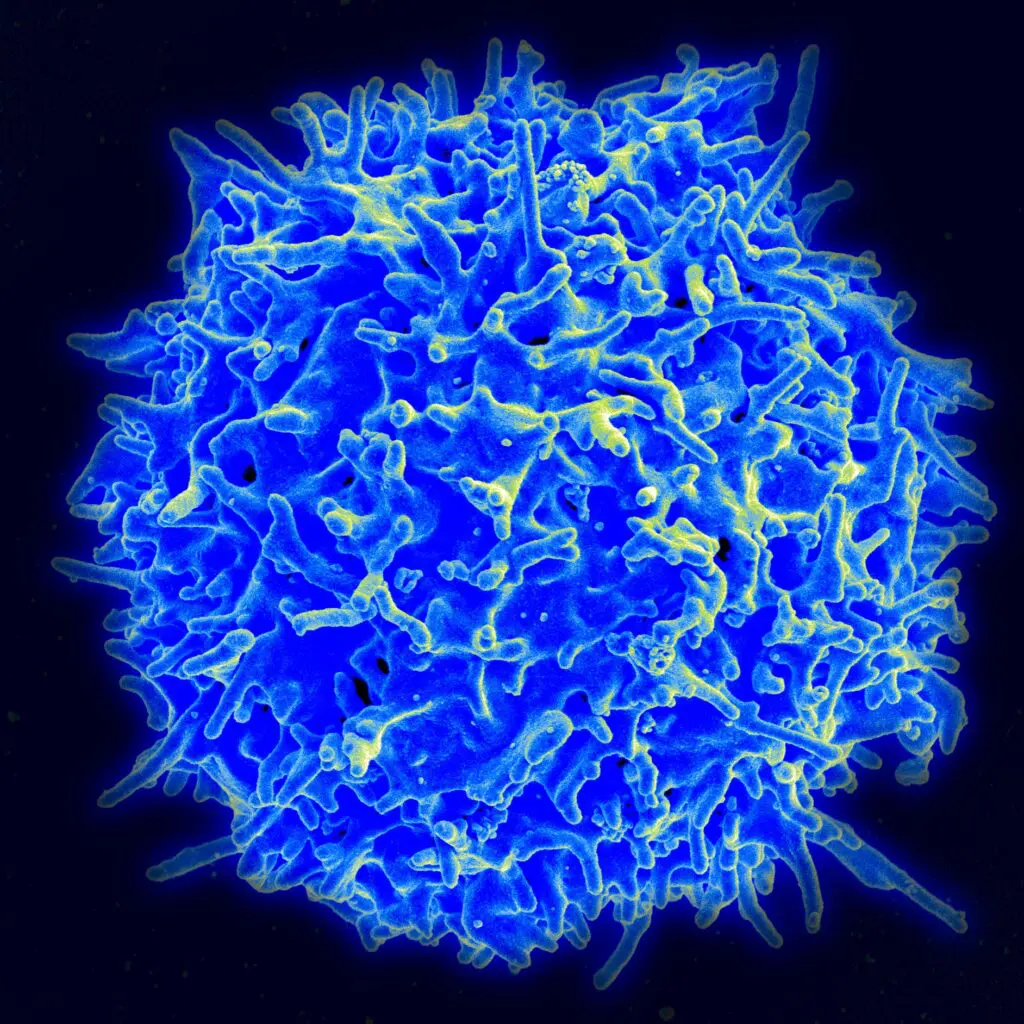
Source: NIAID/NIH
The researchers found that this entrapment happens because stromal cells release a chemical signal called CXCL12, which attracts T cells and holds them in the stromal bands of the tumor. The T cells carry a matching “receiver” called CXCR4. Together, this signal acts like a molecular tether that keeps T cells away from the cancer cells. Importantly, this signaling pathway is used by immune cells but not by the cancer cells, suggesting that blocking CXCR4 could allow T cells to move out of the stroma and into contact with cancer cells.
The study also confirmed a second, independent problem. Even when T cells manage to reach the cancer cells, they are often exhausted or “turned off” by immune checkpoint signals (particularly PD‑1) which act like brakes on the immune system. This helps explain why checkpoint inhibitor drugs on their own have not worked well for most FLC patients. Too few active T cells are making contact with the FLC cancer cells to make a big difference.
To see how these barriers might be overcome, the researchers conducted experiments on human tumor slice cultures. They kept thin slices of living FLC tumors alive in the lab and treated them with different immune therapies:
- a drug that blocks CXCR4
- a PD‑1 inhibitor, and
- both together.
Blocking CXCR4 alone helped T cells move out of the fibrous stroma and into the carcinoma compartments, but the T cells were not fully activated and cancer cell death was limited. Anti PD‑1 treatment alone switched T cells into a more active state, but most still could not reach the carcinoma cells. Neither approach by itself was sufficient.
The biggest effect occurred when both treatments were combined. Blocking CXCR4 allowed T cells to physically enter the carcinoma compartments, and blocking PD‑1 re‑energized those T cells so they could kill cancer cells. Together, these two drugs led to many more activated T cells making contact with actual cancer cells and a much higher level of cancer cell death than either treatment produced on its own. This effect was consistent across multiple patient samples, including metastatic tumors.
In summary, this study shows that fibrolamellar carcinoma escapes the immune system in two main ways:
- by physically keeping T cells separated from the cancer cells in the fibrous stromal bands of the tumor and
- by “turning off” the few T cells that do reach the cancer cells.
Addressing only one of these problems is not enough. By tackling both issues at the same time—letting immune cells reach the cancer cells and restoring their ability to attack—the researchers demonstrate a much stronger immune response against FLC. These findings provide a clear and practical roadmap for future immunotherapy trials in a cancer that urgently needs better treatment options.
Why this paper matters
- It provides the clearest mechanistic explanation to date for immune resistance in FLC.
- It shows that immune failure is not due to lack of antigens, but due to physical exclusion and functional exhaustion.
- It focuses future scientific investigations on: “How do we mobilize immune cells to reach the cancer and turn them on?”
- It provides strong preclinical justification for rational combination trials in FLC.
The full text of the publication can be read here:
Note: This study was funded by a grant from FCF. Tissue samples from FCF’s biobank were also used for the analysis. Thank you to the patients and families who have contributed biospecimens to the FCF biobank!