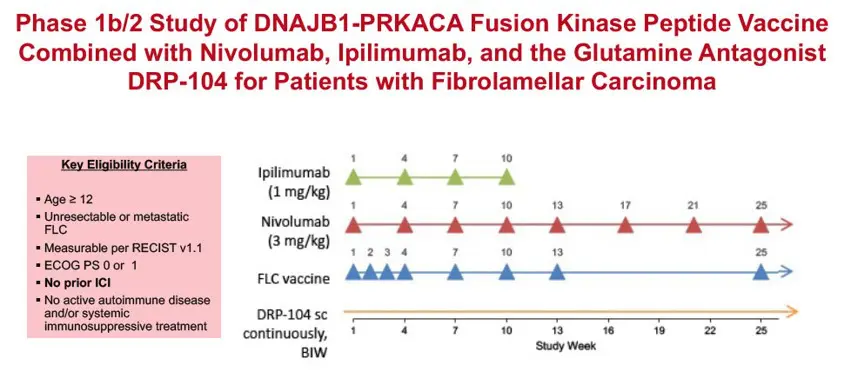

A clinical trial of a new combination immune therapy specifically designed for fibrolamellar carcinoma (FLC) is beginning to enroll patients at the Sidney Kimmel Comprehensive Cancer Center of Johns Hopkins University (Baltimore, MD). The study is led by Drs. Marina Baretti and Mark Yarchoan. Importantly, this trial builds directly on findings from earlier studies that demonstrated the promise of immune-based therapies for FLC.
The new study combines two lines of prior research. The first was a Johns Hopkins clinical trial of a vaccine designed to stimulate immune responses against the DNAJ-PKAc (“DP”) fusion protein, the cancer-driving protein found in more than 99% of FLC tumors. The vaccine was administered together with the immune checkpoint inhibitors nivolumab and ipilimumab. That study showed that most patients developed DP-specific immune responses and that some experienced prolonged disease control and durable remissions. The second line of research focused on DRP-104 (sirpiglenastat), a drug designed to disrupt the abnormal glutamine metabolism of FLC cells and make the tumor microenvironment more favorable for immune attack.
This new “quadruple immune therapy” trial brings these approaches together into a single treatment regimen. By combining a DP-targeted vaccine, dual immune checkpoint blockade, and metabolic therapy with DRP-104, investigators hope to generate stronger, more durable, and more consistent anti-tumor immune responses than have been achieved with previous immune-based treatments for FLC. The four components of the regimen are:
- FLC-Vac – a therapeutic vaccine designed to generate large numbers of immune cells that specifically recognize and destroy cells expressing the DP fusion protein
- Ipilimumab – an inhibitor of the CTLA-4 immune checkpoint
- Nivolumab – an inhibitor of the PD-1 immune checkpoint
- DRP-104 (sirpiglenastat) – a drug that interferes with glutamine metabolism by inhibiting multiple glutamine-utilizing enzymes
FLC Cancer Vaccines
Two independent clinical studies at the University of Tübingen and at Johns Hopkins, convincingly demonstrated that the DP fusion protein can be selectively targeted by the immune system. In those trials, patients received a vaccine containing a short synthetic peptide (protein fragment) spanning the unique junction where the DNAJB1 and PRKACA proteins are fused together. Vaccination stimulated a substantial expansion of T cells (a type of immune cell) capable of recognizing the DP fusion protein and attacking FLC cells while sparing normal tissues. These findings provided proof that the immune system can be trained to recognize one of the fundamental drivers of FLC.
The first published clinical evidence for this approach came from a case study reported by researchers at the University of Tübingen in Nature Communications in 2022. The report described a patient who received the vaccine after experiencing repeated tumor recurrences following a liver transplant. Since receiving the vaccine, the patient has remained free of detectable disease and has experienced no further recurrences, providing an early indication of the potential of this strategy.
Immune Checkpoint Inhibitors
Nivolumab (nivo) and ipilimumab (ipi) are immune checkpoint inhibitors (ICIs) approved to treat a variety of cancers. These drugs work by blocking molecular signals that normally act as brakes on the immune system. While these checkpoints help prevent excessive immune reactions and autoimmune disease, cancer cells can exploit them to evade attack by tumor-fighting T cells. By blocking these inhibitory signals, ICIs restore the ability of T cells to recognize and destroy cancer cells.
The introduction of ICIs revolutionized cancer therapy. In 2011, ipilimumab, which blocks the CTLA-4 immune checkpoint, became the first immune checkpoint inhibitor approved by the U.S. Food and Drug Administration (FDA). ICIs targeting the PD-1 checkpoint system, including pembrolizumab and nivolumab (nivo), followed several years later. Today in the United States approximately half a million cancer patients per year receive ICI therapy.
Although ICIs have had a major impact in several cancers, including melanoma and lung cancer, their activity as single agents in FLC has been limited. Available data suggest response rates of approximately 15%, with median progression-free survival of less than six months. However, a small number of exceptional responses have demonstrated the potential of this approach. Two published case reports describe patients with advanced FLC who achieved remarkable outcomes after treatment with the combination of nivolumab and ipilimumab. In one case, dual checkpoint blockade produced a complete response in a patient whose cancer had progressed despite multiple prior therapies, including another checkpoint inhibitor. More than six years later, that patient remains free of detectable disease. These observations suggest that while checkpoint inhibition alone is unlikely to be sufficient for most patients, it can contribute to deep and durable responses when effective anti-tumor immunity is generated.
Combined Therapy with FLC-VAC and ICIs
In April 2019, with initial grant support from FCF, the team at Johns Hopkins began a Phase 1 clinical trial in FLC patients of the FLC-VAC peptide combined with nivolumab and ipilimumab (clinaltrials.gov identifier NCT04248569). An in-depth report on the first 12 evaluable patients from the study appeared in Nature Medicine in November 2025. The results were highly encouraging:
- None of the patients suffered major (grade 4-5) treatment-related toxicity
- 9 of 12 patients developed T-cell immunity to the fusion-specific peptide vaccine
- 6 of the 9 who developed T-cell immunity (and none of those who failed to do so) obtained a significant stabilization of their cancer (i.e., greatly diminished rate of tumor growth) lasting at least 6 months
- The other 3 of the 9 patients who developed T-cell immunity had deep partial responses, a significant decrease in their tumor burden. Of those patients:
- Two elected to have localized residual disease surgically resected
- The third patient’s final evident cancer, a single metastatic nodule, disappeared after administration of an additional dose of ipilimumab.
Importantly, all 3 of these patients remain free of evident cancer today, up to 6 years after completion of the vaccine plus dual ICI therapy. No comparable results have been seen in any other FLC clinical trial.
Why Add DRP-104?
One of the key questions raised by the clinical studies at Johns Hopkins and Tübingen is why some patients achieve strong and durable responses to immune therapy while others experience more limited benefit. Recent research suggests that differences in tumor metabolism may play an important role. Studies of DP-driven cancer cells indicate that FLC creates a tumor environment that can suppress anti-tumor immune responses, potentially limiting the effectiveness of otherwise promising immunotherapies.
Many cancers rely heavily on glutamine, an amino acid that serves as an important source of energy and raw materials for cellular growth. Recent work from the Yarchoan laboratory and collaborators (Kamdar et al., Journal of Hepatology, 2025) showed that the DP fusion protein rewires cellular metabolism, making FLC cells unusually dependent on glutamine. This “glutamine addiction” fuels tumor growth and survival by supporting the production of DNA, RNA, proteins, and other molecules required by rapidly growing cancer cells.
This altered metabolism may also impair the immune system’s ability to attack the tumor. FLC cells consume large amounts of nutrients needed by immune cells and may create a metabolically hostile tumor microenvironment. In particular, glutamine metabolism generates ammonia, a byproduct that can accumulate both within tumors and in the bloodstream of some FLC patients. Growing evidence from multiple cancer types suggests that excess ammonia can promote T-cell exhaustion, reduce the cancer-killing activity of T cells and natural killer (NK) cells, and favor the activity of immunosuppressive regulatory T cells. Together, these effects may help tumors evade immune attack.
DRP-104 (sirpiglenastat) was developed to address these metabolic barriers. The drug is a redesigned version of DON (6-diazo-5-oxo-L-norleucine), a glutamine-blocking agent first identified in the 1950s. Although DON showed anti-cancer activity, its clinical development was abandoned because of unacceptable gastrointestinal side effects. Researchers at Johns Hopkins subsequently developed a series of DON prodrugs designed to deliver the active compound preferentially to tumors while minimizing exposure to normal tissues. DRP-104 is one of these next-generation compounds. It is converted to the active drug within tumors while remaining largely inactive in normal gastrointestinal tissue, substantially improving tolerability.
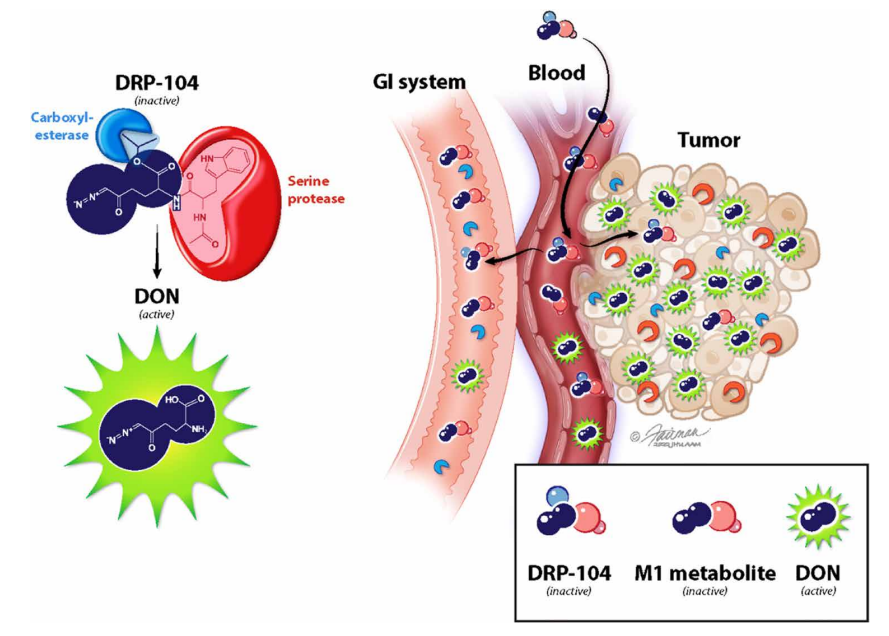
Illustration from Science Advances (Rais et al., Sci. Adv. 8, eabq5925 (2022))
Early clinical experience with DRP-104 has also been encouraging. In a study of patients with FLC, six patients received DRP-104 in combination with an immune checkpoint inhibitor. The trial established the safety and tolerability of the combination and confirmed that DRP-104 can reduce elevated ammonia levels, providing evidence that the drug is affecting the glutamine-driven metabolic abnormalities associated with FLC. These findings supported further evaluation of DRP-104 as a potential partner for immune-based therapies.
DRP-104 is being added to the vaccine and checkpoint inhibitor regimen for two reasons:
- First, it may directly impair the growth and survival of FLC cells by disrupting their dependence on glutamine metabolism.
- Second, it may improve anti-tumor immunity by creating a tumor environment that is more favorable for T-cell function.
Earlier studies of DON-based prodrugs demonstrated both anti-tumor activity and enhancement of immune responses in preclinical cancer models. More recently, Kamdar and colleagues extended these findings to a mouse model of DP-driven liver cancer, providing a strong scientific rationale for evaluating DRP-104 in combination with DP-targeted immunotherapy in patients with FLC.